This was published in Quadrant Online under the title, ‘You’ll be Sorry When We’re Gone’ – here.
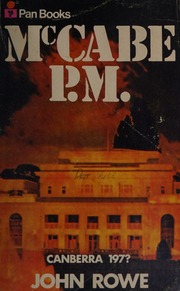
In his 1972 novel, McCabe PM, John Rowe tells the story of a maverick Prime Minister from New South Wales Prime whose authoritarian tendencies reach the point where, after South Australia and Western Australia announce their intentions to secede, he prepares Defence to undertake city-edge bombing of Adelaide and Perth. More than fifty years on, much can be drawn from Rowe’s prescient work, and, as a novel that would be rewarding for educators and students alike, my recommendation is that it be added as a text in Australian Literature and Sociology curricula.
For contemporary Australia, the themes of Rowe’s novel run deep. Putting Western Australia to one side for the moment, one theme to be explored is the bombing of Adelaide and how, whilst the bombing these days takes the form of insults, the east-coast air-raid never relents. Students could be encouraged to augment their essays by searching online for examples, where they might find former SBS sports and weather presenter, Lucy Zelic, who on 3 September 2019 on The World Game, interviewing a soccer player recently arrived from Scotland, warned him off the South Australian capital. ‘You won’t see much in Adelaide… Adelaide’s a shithole’. Or they could come across actor Sam Neill who, living in Sydney in 2016, was lamenting the effects that the CBD lock-out was having on Sydney nightlife. ‘I don’t want to see Adelaide being a place you go to for a good weekend’. A degree of latitude should also be granted to students who reference bombs dropped by accident, such as that by Scott Morrison on 13 February 2022. In Adelaide to support South Australian Premier Steven Marshall in his re-election campaign, Morisson was intending to refer to Adelaide’s north-south corridor project as ‘city shaping’, but his first word came out as ‘shitty’, which he corrected to ‘city’, becoming: ‘this… shitty… city’. For an essay to pass, a minimum requirement would be the citing of material of this kind, which is available in abundance.
More enterprising students would analyse the motives for bombing Adelaide. Here they would strike some golden sociological nuggets. The bombing of Adelaide, they would be likely to discover, is done to serve one or more of three ends: to win admiration from people in Sydney or Melbourne, to acquire new friends in Sydney or Melbourne, or to advance one’s career in Sydney or Melbourne. Of the cases studies available, one is Tom Elliott, a broadcaster at 3AW. Ellliott, who has difficulty with the Englishness of the Adelaide accent, frequently disparages South Australia, in 2022 telling his listeners that if Adelaide was blown off the surface of the earth, no one would notice or care. In January 2024, Elliott was promoted to 3AW’s morning slot at the expense of Neil Mitchell. Occasionally, even an Adelaide resident, sensing the opportunities to be derived from east-coast alliances, has bombed their own town. Students could write about song-writer, Paul Kelly, who was educated at one of Adelaide’s best private schools but moved to Melbourne and saw his fan-base grow with his song, ‘Adelaide’, which rubbishes the place. So successful has this career ploy consistently proven to be, an incisive student might observe, that if you are applying for a job in Sydney or Melbourne, forget about your PhD or MBA. Make a joke at Adelaide’s expense.
An associated sociological phenomenon is that of othering, whereby people define themselves by way of a contrast with those they deem inferior. On this, students will find not only that bombing Adelaide is a way of life in Sydney and Melbourne, but that for the residents of those two cities, Adelaide is necessary to make them feel good about themselves. One high-profile exponent of this, they might find, has been Dominic Perrottet, who ascended to the Office of Premier of New South Wales on an anti-Adelaide platform. Perrottet first came to attention in 2018 when asked for his opinion on a digital driving license being developed in South Australia. ‘Pretty poor, like most things in Adelaide’. And later that same year, he boosted his credentials further when speaking about immigration and the need for the load to be shared by the capital cities. ‘Nobody wants to go and live in Adelaide… that’s just the reality’. Perrottet served as Premier of New South Wales from October 2021 until March 2023, when he lost to Chris Minns, but even during the election campaign he sought to cling to power by reminding Sydney-siders of how well they compare with Adelaideans. ‘I get in trouble for attacking Adelaide, but it wouldn’t be a speech about Sydney if I didn’t’.
The thinking student could also draw on Rowe’s novel to tease out chinks in the Australian ethos of egalitarianism. Adelaide has never been anything but a mis-fit in the Australian egalitarian landscape, they could argue. To begin with, this was because Adelaide saw itself as a cut above. Established by Westminster legislation as a British province, Adelaide was the apple of England’s eye. When the first ever royal visit to Australia took place in 1867, Prince Alfred, second son of Queen Victoria, sailed around to dock in Adelaide first, and visitors Anthony Trollope and Mark Twain both described Adelaide as Australia’s most cultivated city. The turning point came in 1905 when a Scottish actress living in Adelaide, Thistle Anderson, writing behind the shield of a pseudonym, as some critics of Adelaide still do, dropped a bomb with Arcadian Adelaide, a small book which held nothing in reserve in its exposé of South Australian pretentiousness and hypocrisy. As others followed with bombs of their own, throughout the twentieth century, Adelaide diminished further and further in stature, and, as of today, has fallen so far that it barely registers in east-coast consciousness. A Distinction-level essay might point out that in 2025 the people of Sydney, whilst they have heard of Adelaide, are not quite sure where it is.
But the other theme in Rowe’s novel is secession. This is where Western Australia could find a place in student writing. Students would be required to evaluate which of Western Australia and South Australia has been bombed the most severely over time, and to assess the merit of the West Australian secession threat, which is premised on geographical distance, against the South Australian threat, which rests on cultural difference. Which has the stronger entitlement to secede? The weight of evidence favours South Australia. The gulf between Adelaide and the rest of the country, students could assert, is widening. Adelaide is seen as too different, too un-Australian – an east-coast observation which South Australians themselves might receive as a compliment. Students would do well to suggest in their conclusions that, in coming years when the rest of the country votes to become a republic, South Australia make the break and stay with England.
McCabe PM has long been out of print but I urge the publisher to revive it with a new annotated edition prefaced by a scholarly Introduction. The author of that Introduction needs to be even-handed and unjaundiced. I make myself available.
~~~
 Home
Home 
Leave a comment