Published in The Spectator Australia – here.
Talking recently with an old acquaintance, now a barrister, I spoke of how disappointing it was that the High Court had declined the special leave application brought by Sall Grover in the Tickle v Giggle case. The High Court ruled that the wording of the Sex Discrimination Act was not sufficiently ambiguous to allow for argument, but if the judges had heard the case, their written judgments could have become legal folklore, drawing upon historical precedents concerned with the definitions of ‘man’ and ‘woman’ and, where appropriate, quoting works of literature.
For, as I explained, I had just read a book called Literature, Judges and the Law, which reviews instances through history where judges have ennobled themselves all the more by invoking literary imagery in their judgments. Written by the late Irish legal historian, Nial Osborough, the book suggests that, provided the allusion to literature sensibly augments the reasoning of the judgment, and is not perceived as judicial affectation, it further enhances the already exalted intellectual standing of the judge.
Although not a close friend, I had always looked up to this barrister, and, in the hope of impressing him, I mentioned that I had the perfect literary reference the judges could have used if they had heard Tickle v Giggle. He seemed non-plussed but agreed to hear me out.
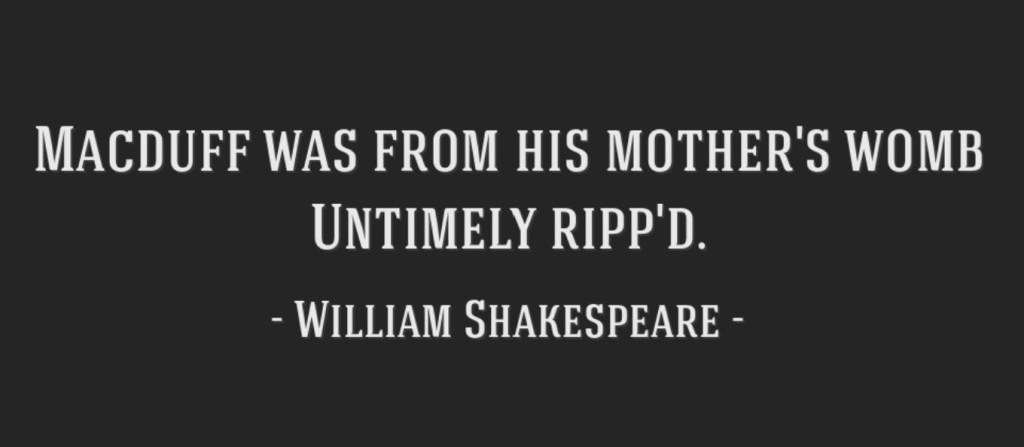
On the question of whether a trans-woman is in law a woman, I explained, judges finding for Sall Grover could have called upon Macbeth, no less. In the fourth Act, the witches, having prophesied that Macbeth will become king, offer him various proofs of his invincibility, including that ‘None of woman born shall harm Macbeth’. However, as his evil reign nears its end, one by one these proofs are negated, and in the final Act when Macbeth, challenged by Macduff and confronting his fate, tells of this one remaining safeguard, Macduff delivers the climactic line: ‘MacDuff was from his mother’s womb untimely ripped’.
Never before has this line been quoted by a judge and, surely, I said, never before has a literary reference from any source at all been so apposite to the question before the court. By incorporating it into their judgment, the gavel would have fallen with a clap of Shakespearean thunder − a woman is, and only is, someone in bodily possession of a conventional birthing canal.
He remained expressionless and silent, but I had more.
Then, it so happens that judges finding for Roxanne Tickle could have drawn upon the corresponding line in a recent Australian adaptation of Macbeth. This is the 2026 Bell Shakespeare production, Mackenzie, written by Yve Blake, where the plot of Macbeth is transposed on to the set of a teenage television drama. The ambitious teen actor, Mackenzie, is told by an eccentric old make-up artist that she will become the number one girl star in the world, and that, amongst other assurances, ‘no one born of a woman’ will stand in her way. Mackenzie ascends the ladder of success, ending the careers of her rivals by harming them physically or reputationally, and in the final scene, when the on-set chef, Gayle, threatens to expose the truth of Mackenzie’s deeds, and Mackenzie calls upon the assurance she had been given, Gayle delivers the decisive blow: ‘my birth parent was non-binary’.
I asked the barrister which of the two, Macbeth or Mackenzie, did he consider the more potent literary reference. For me, the answer was clear, and, as I mentioned to him in an effort to lighten him up, if only our judges had allowed Sall Grover’s application and I had found a way to submit the Macbeth idea to them − I could have sat quietly the rest of my days knowing I had contributed to a famous judgment.
‘It is Mackenzie or nothing’, he finally said, before proceeding to give his ‘frank views’ on the matter. ‘The whole premise of your little fantasy is mistaken’, he said. Australian judges should not be citing the likes of Shakespeare at all. Read the Commonwealth Law Reports, he explained, and you will see that Australian judges rarely quote anything other than the Bible, Shakespeare, and a smattering of Dickens, mainly Bleak House and Oliver Twist. Look for example at the judgments of Michael Kirby or, of the current High Court Justices, James Edeman. It is a practice that is anachronistic and also hypocritical. We are talking about judges who interpret the constitution as a living document that moves with the times whilst harking back to the Book of Job and The Merchant of Venice. It is judicial vanity, no more no less, he continued. The judges are signaling that people of their ilk keep company with the greatest minds.
Lost for words, I tried to steer him back to my question, asking him why he thought the Mackenzie adaptation was more persuasive than the original Macbeth.
For one thing, he said with irritation, Mackenzie reflects the law of the land in Australia. Any performance of Macbeth is in breach of the Sex Discrimination Act. But more to the point, Mackenzie is Australian. Our judges need to lose their airs and graces and, if they are to cite literature at all, it must be Australian, the kind that people in this country can understand and relate to, even if they disagree with it. As an Australian adaptation of Macbeth, Mackenzie would have made an ideal starting point, serving as a bridge between medieval England and modern Australia.
That night, thinking back on this conversation, I was saddened by the barrister’s outlook on the world. Never had I met someone who harboured such cynicism towards Australia’s highest judicial officers. I could only conclude that he must be a deeply unhappy person. He should read Professor Osborough’s book, which demonstrates that judges are and always have been public servants in the true sense. Or as Lord Brougham wrote in a timeless judgment in 1844, citing Lucretius, judges are people of ‘unsullied character… who occupy unmoved and serene the elevated heights’ of their position, with no view to self aggrandisement.
~~~


Leave a Reply